Mushroom
How Long Have Humans Been Using Psychedelic Mushrooms?
Jan
Humans have interacted with psychedelic mushrooms for far longer than written history can fully record. Across continents and cultures, these fungi appear in ancient art, oral traditions, and ceremonial practices that stretch back thousands of years. Consequently, understanding how long humans have been using psychedelic mushrooms helps explain why they continue to inspire scientific research, cultural curiosity, and philosophical discussion today. In this comprehensive, educational guide, PsychedelicShroomly explores archaeological evidence, indigenous traditions, and modern rediscovery to trace humanity’s enduring relationship with psilocybin-containing mushrooms.
The Earliest Evidence of Psychedelic Mushroom Use
When written records are absent, archaeology provides clues. Although mushrooms themselves rarely fossilize, human expression leaves traces. As a result, researchers rely on rock art, sculptures, and symbolic artifacts to reconstruct early use.
Ancient Rock Art and Cave Paintings
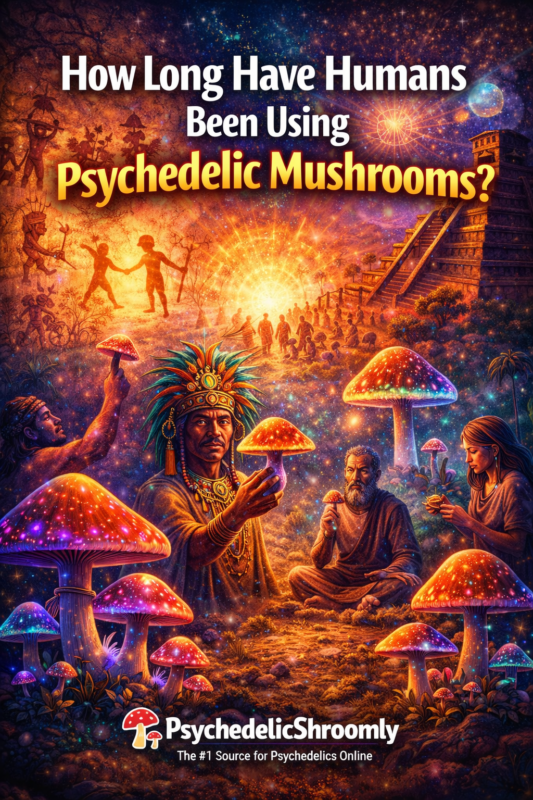
Some of the earliest suspected depictions of psychedelic mushrooms appear in prehistoric cave paintings. In parts of North Africa and Europe, rock art dated to as early as 7,000–9,000 years ago shows humanoid figures holding mushroom-like shapes. Because these images often appear in ritual contexts, scholars suggest they may represent altered states of consciousness.
Similarly, in the Tassili n’Ajjer region of Algeria, cave paintings depict figures with mushroom-shaped heads and dynamic postures. Therefore, many anthropologists interpret these as symbolic references to psychoactive mushroom experiences rather than simple food gathering scenes.
Archaeological Interpretations and Caution
It is important to note that interpretations vary. While some researchers strongly support the idea of early psychedelic mushroom use, others urge caution. Nevertheless, the recurring presence of mushroom symbolism across regions strengthens the argument that humans recognized unusual properties in these fungi long ago.
PsychedelicShroomly highlights this evidence to show how curiosity about altered perception predates modern science by millennia.
Psychedelic Mushrooms in Ancient Civilizations
As human societies became more structured, the role of psychoactive plants and fungi also evolved. Consequently, psychedelic mushrooms became embedded in spiritual and ceremonial systems.
Mesoamerica: The Best-Documented History
The clearest historical evidence comes from Mesoamerica, particularly among the Aztec, Maya, and other Indigenous groups. These cultures referred to psilocybin mushrooms as “teonanácatl,” meaning “flesh of the gods.”
Spanish chroniclers in the 16th century documented mushroom ceremonies involving music, chanting, and spiritual reflection. Although colonial authorities attempted to suppress these practices, they persisted in remote regions. Therefore, Mesoamerica remains central to understanding how long humans have been using psychedelic mushrooms.
Sacred Rituals and Social Meaning
Rather than casual use, psychedelic mushrooms were treated as sacred tools. They were consumed during important ceremonies related to healing, divination, and community decision-making. Because of this, their role was both spiritual and social.
Educational resources on PsychedelicShroomly emphasize this respectful, cultural context to help readers understand historical use beyond modern stereotypes.
Indigenous Traditions That Survived Colonization
Despite centuries of suppression, some Indigenous communities preserved mushroom knowledge through oral tradition. As a result, living practices still exist today.
The Mazatec People of Mexico
The Mazatec community in Oaxaca is particularly well known for preserving ceremonial mushroom use. Curanderos and curanderas (traditional healers) used mushrooms in nighttime rituals focused on guidance, healing, and insight.
These ceremonies were structured, intentional, and guided by experienced practitioners. Therefore, they provide invaluable insight into how psychedelic mushrooms were traditionally understood.
Oral Knowledge and Cultural Continuity
Because these traditions were passed down orally, they adapted over time. However, their core purpose remained the same: facilitating understanding, balance, and connection. PsychedelicShroomly frequently references these traditions to honor their historical significance.
Psychedelic Mushrooms in Other Regions of the World
While Mesoamerica offers the most direct evidence, it is not the only region where psychedelic mushrooms likely played a role.
Asia and Siberia
In parts of Siberia, shamans are believed to have used psychoactive fungi, although the species involved may have varied. Some traditions suggest altered states were central to shamanic practices, which often involved drumming, chanting, and plant-based preparations.
Europe and the Ancient World
European folklore contains references to enchanted mushrooms, fairy rings, and altered perception. Although direct evidence of psilocybin use is limited, symbolic language suggests an awareness of mind-altering fungi.
Because of this global distribution of mushroom symbolism, researchers argue that human interaction with psychedelic mushrooms likely emerged independently across cultures.
The Loss and Rediscovery of Mushroom Knowledge
For centuries, much of this knowledge remained hidden or misunderstood. However, the modern era brought renewed interest.
Suppression During the Colonial Era
Colonial powers often viewed Indigenous mushroom rituals as heretical. As a result, many practices were driven underground. Written records were destroyed, and ceremonial use was discouraged or punished.
Nevertheless, knowledge survived through oral tradition. This survival allowed for rediscovery centuries later.
The 20th-Century Rediscovery
In the 1950s, Western researchers and ethnomycologists began documenting surviving mushroom ceremonies. These discoveries sparked scientific curiosity and cultural fascination.
Soon after, psilocybin was isolated and studied in laboratory settings. Consequently, psychedelic mushrooms entered academic and medical discussions for the first time in the modern era.
PsychedelicShroomly tracks this historical shift to show how ancient practices influenced contemporary research.
How Science Views Ancient Psychedelic Use Today
Modern neuroscience provides tools to understand why ancient cultures valued psychedelic mushrooms.
Psilocybin and the Brain
Psilocybin affects serotonin receptors, influencing perception, emotion, and cognition. Therefore, the profound experiences described in historical accounts align with measurable brain activity observed today.
Neuroplasticity and Insight
Recent research suggests that psilocybin may increase neuroplasticity. This finding helps explain why ancient users associated mushrooms with insight, healing, and transformation.
By connecting ancient use with modern science, PsychedelicShroomly bridges history and contemporary understanding.
Why Humans Have Continued Using Psychedelic Mushrooms
The persistence of psychedelic mushroom use raises an important question: why have humans returned to them repeatedly across history?
Curiosity and Consciousness
Humans are naturally curious about consciousness. Psychedelic mushrooms offer a way to explore perception beyond ordinary experience. As a result, they have remained relevant across eras.
Cultural Meaning and Identity
For many cultures, mushrooms were not substances but symbols. They represented connection to nature, community, and the unseen. Therefore, their use reinforced cultural identity.
Ethical and Educational Perspectives
Today, discussion around psychedelic mushrooms emphasizes education, research, and cultural respect.
Learning From the Past
Understanding how long humans have been using psychedelic mushrooms encourages responsible dialogue. Rather than novelty, they represent an ancient relationship between humans and nature.
The Role of Educational Platforms
PsychedelicShroomly positions itself as a trusted educational resource, helping readers explore history, science, and culture without misinformation or sensationalism.
A Timeline Summary of Psychedelic Mushroom Use
- Prehistoric era: Possible use depicted in rock art (7,000+ years ago)
- Ancient civilizations: Ritual use in Mesoamerica and other regions
- Colonial period: Suppression and loss of written records
- 20th century: Rediscovery and scientific study
- Modern era: Renewed research and cultural interest
This timeline highlights the remarkable continuity of human interaction with psychedelic mushrooms.
